
The Fall of Hassans Wall, 36cm x 50cm, acrylic on canvas, 2025
The Fall of Hassans Wall, 36cm x 50cm, acrylic on canvas, 2025
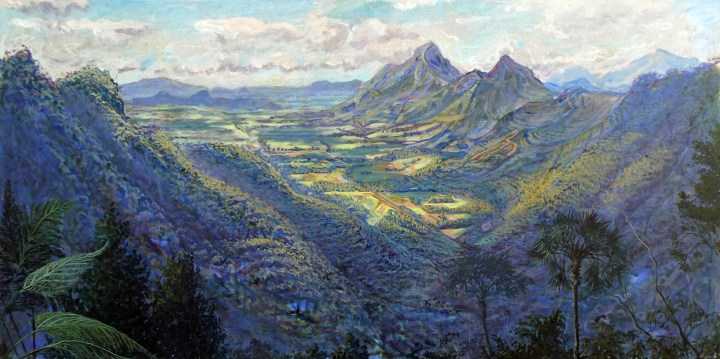
Up in Eungella, 46cm x 91cm, acrylic on canvas, Plein air with studio finishes, 2023
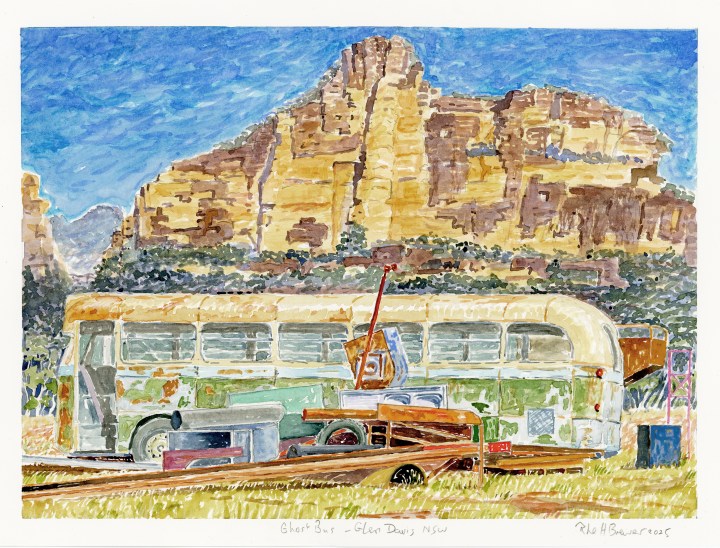
Ghost Bus, 31cm x 41cm, watercolour on paper, framed, 2025
The old government bus has come to rest in an abandoned Ghost Town, settled into a beautiful ancient canyon on the western side of the Blue Mountains.
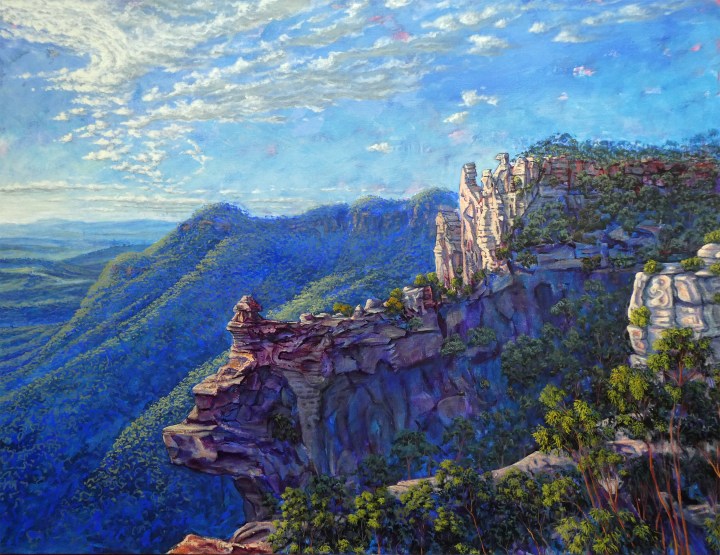
Afternoon at Narrow Neck, 101cm x 132cm,acrylic on canvas, framed in Tasmanian Oak, 2025. This picture is not available , It was commissioned from this website.
I made this work as a result of a query from a couple who view my website and saw my Blue Mountains paintings. They wanted an image of a place special to them. It happened to be a place that I love painting. The work was made from a series of photographs that I took in the last Summer days of 2024 and the mountains turned on a spectacular sunset that evening. This vantage point is about halfway along the dirt road that leads across Narrow Neck, near Katoomba.
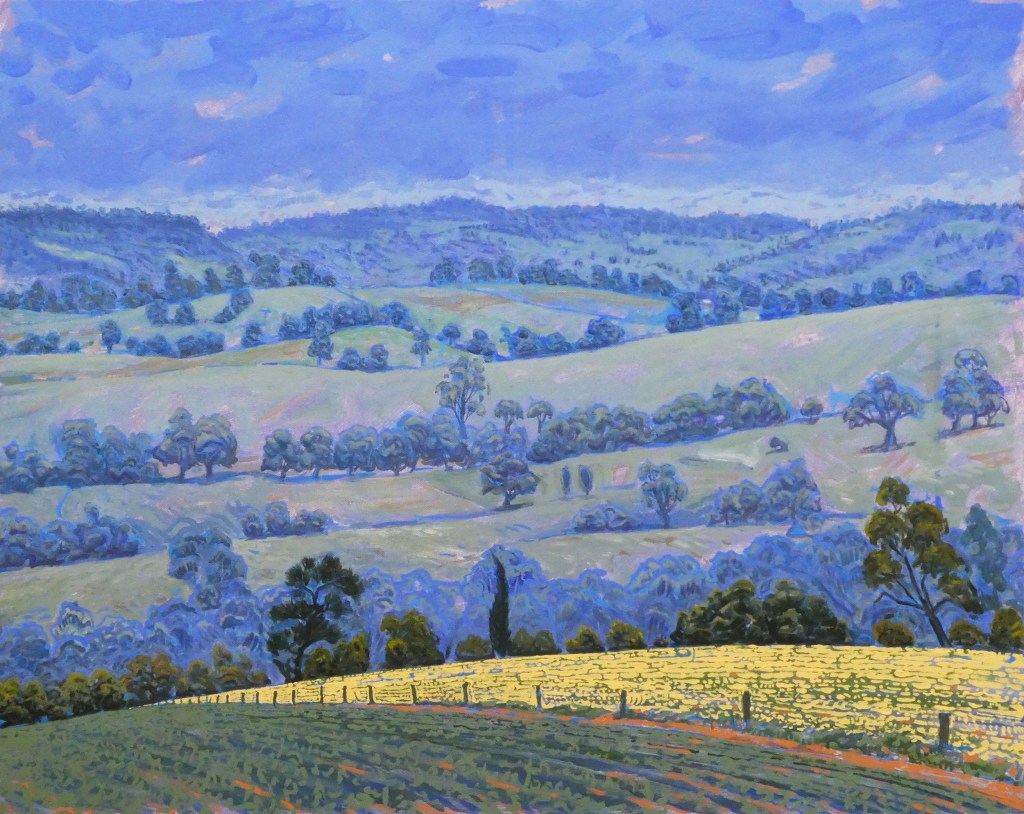
Canola in Blue, 61cm x 72cm, acrylic on canvas , framed, 2024
Canola crops are impossible to ignore around Cowra. On a hazy day, when the landscape takes on a blue hue, the Canola makes a statement.
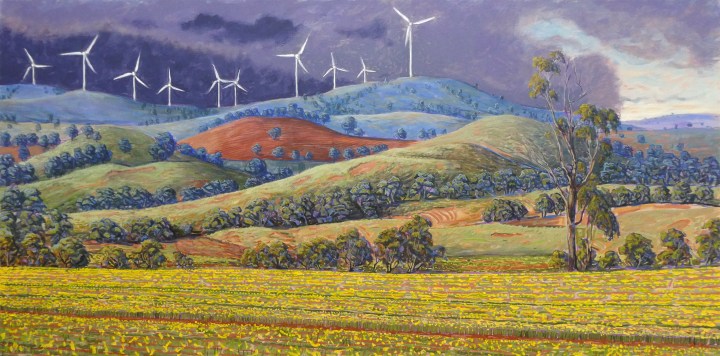
Canola and wind Farm, 61cm x 122cm, acrylic on canvas- framed, 2024 (sold)
This painting had its own ideas about how it should end up. It kept suggesting changes to me and it became an arm wrestle between painter and painting. Artists will understand that what you envision for a work, and what it becomes can sometimes be two very different things. I’m happy that I was able to be persuaded.
It depicts the Canola crops, hills, and a wind farm in central western NSW, as a storm front approaches.
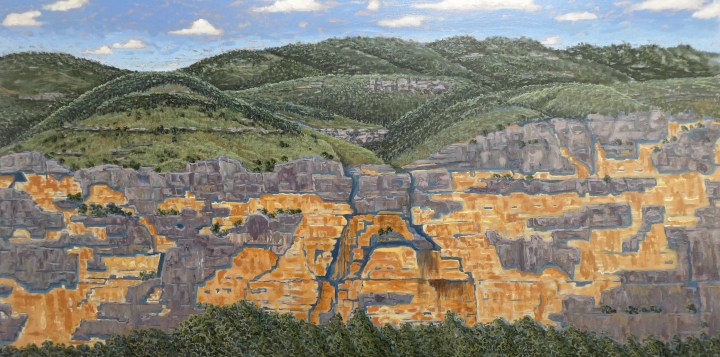
Across the Wall from Evans Lookout, 61cm x 122cm, acrylic on linen, 2024
The opposite wall of a deep squared off ravine which is where the Grose Valley begins in the Blue Mountains, west of Sydney. I thought it looked like a Medieval Fortress.
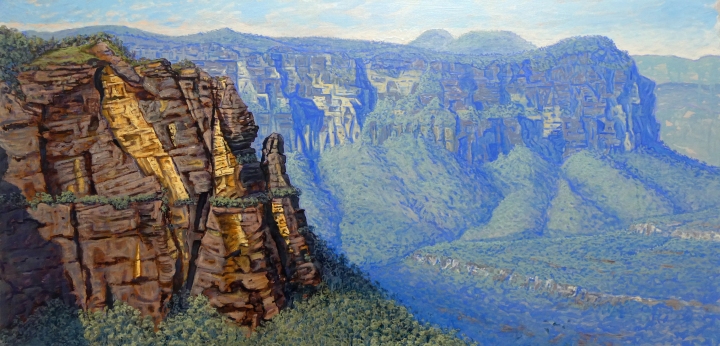
Beyond the Pulpit, 61cm x 122cm, acrylic on linen, 2024 sold
Most of the lookouts and landmarks in the Blue Mountains were named by British Explorers in the Nineteenth Century who were unaware or simply not very interested in the place names given by the predominantly Darug and Gundungurra people, indigenous to the area. Many of these explorers and pioneers were religious and church attendance was still high. Hence, we get names like Pulpit Rock. They liked that name so much that they used it again for another rock form near Mount Victoria a few kilometers along the western track to the potential farmland below the Western escarpment. The Nineteenth Century was ironically the same time that Romanticism, with its reverence for the natural world with its sublime beauty, and awe inspiring power to create and destroy, was the dominant force in European art. Many people were starting to take a renewed interest in the beauty of nature that had more to do with their distant ancestors’ Pantheistic beliefs, and less to do with the centuries of Christian doctrine they had brought with them from Europe. My title for this painting hints at the changes in thinking that were happening during the first half of the Nineteenth Century and our inherited love, and sometimes fear, of a more natural and challenging landscape.

Canola, and distant Hills, 61cm x 122cm, acrylic on canvas, 2023– sold
I was driving on the Mid Western Highway, on my way to Cowra and I had to stop and take photographs of the spectacular display of vivid yellow from a Canola crop near Woodstock, NSW- sold
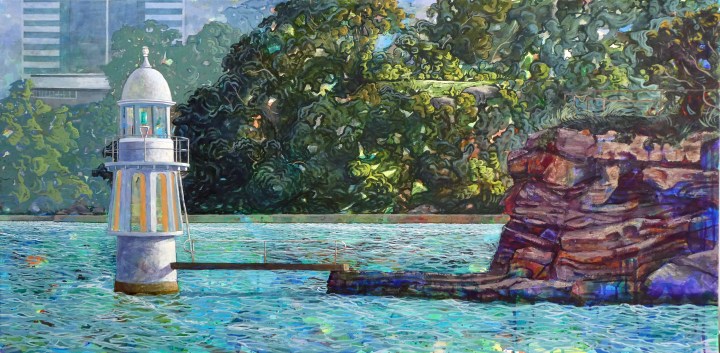
Robertsons lighthouse, Cremorne Point, acrylic on linen, 61cm x122cm, 2024
Entered in 2024 Mosman Art Walk due January 2024
 Rhett Brewer - Artist